A citation is a source an AI answer shows to back up what it says. Here is how citations differ from backlinks and keywords, and how to earn the right ones.
Your rankings are solid and your backlinks are healthy, yet when someone asks ChatGPT or Google's AI for options in your category, your brand is not in the answer. AI citations are a good place to start looking, and we think the work behind citations in AI answers differs from ordinary SEO.
What Is a Citation in an AI Answer?
A citation is a source an AI answer shows to back up what it says, such as a review site, a news article or a directory listing.
In A2ZReach, we capture the domain, where it appeared and which brand it supports for every citation in every response. We then add them up across your tracked prompts, so you can see which domains are cited most in your category. See our citation intelligence docs.
A page can mention your brand and still be cited to support a competitor. We call this the conversion gap: your name is on the page, but the answer uses the page as evidence for someone else.
Why Do AI Citations Matter?
Citations show where an answer's claims come from, so they show who shapes what AI says about your category.
Two findings stand out.
Few people click through. Pew's July 2025 analysis (opens in a new tab) tracked 900 U.S. adults on Google in March 2025. With an AI summary, they clicked a traditional result on 8% of visits, against 15% without one, and clicked a link inside the summary on 1%. We read this as: the sources behind the answer matter more than the links under it.
One answer is not a signal. SparkToro's January 2026 research (opens in a new tab) ran 12 prompts through ChatGPT, Claude and Google's AI 2,961 times. It found less than a 1-in-100 chance that two responses to the same prompt give the same list of brands. It was not peer-reviewed and a co-author works for an AI-tracking company, so treat it as directional.
How Do AI Citations Differ from Backlinks and Keywords?
A keyword matches a query, a backlink is a link from one site to another, and a citation is a source an AI answer shows to support what it says.
| Keyword | Backlink | Citation in an AI answer | |
|---|---|---|---|
| What it is | A term that matches a query | A link from one site to another | A source an AI answer shows to support what it says |
| Who places it | The writer | The site that links | The AI engine, for each answer |
| What it tells you | Which queries a page is written for | Which sites point to a page | Which pages an answer drew on |
The evidence on how they relate is thin and mostly from vendors. Ahrefs, which sells SEO software, studied 75,000 brands (opens in a new tab). Branded web mentions correlated with brand mentions in Google AI Overviews at 0.664, and backlinks at 0.218. The author says mentions "appear to be more impactful than link building," but stresses that correlation is not causation. The study covers AI Overviews only.
Google's AI features documentation (opens in a new tab) says no special optimization is needed beyond being indexed and eligible for a snippet.
Why Has Earned Media Become More Important in AI Search?
Research finds AI answers lean on independent, third-party sources, and Google says inauthentic mentions are not as helpful as they seem.
In the University of Toronto paper Generative Engine Optimization: How to Dominate AI Search (opens in a new tab) (September 2025), earned media means independent media, review sites and comparison sites. Across 1,000 consumer ranking prompts in the U.S. and Canada, AI search favored earned sources over brand and social content far more than Google did. For software, earned sources were about 32% of Google's cited domains in Canada and about 74% for AI search. GPT-4o did much of the labeling, and the findings cover consumer product queries only.
Muck Rack (opens in a new tab) sells PR software and runs its own study. It analyzed more than 25 million links cited by ChatGPT, Claude and Gemini, and reports earned media at 84% of citations and paid content at 0.3%. Its page gives no methodology details.
Google's AI optimization guide (opens in a new tab) says AI features can show what others say about your products across blogs, videos and forums, and that pursuing inauthentic mentions is "not as helpful as it seems."
Our take on earned media in AI search: both studies lean toward independent coverage, and Google does not tell you to buy it. Your own site still matters: in the example account below, Directory and Brand Site are the two largest categories.
How Do You Build Content Worth Citing?
Write from first-hand expertise, keep pages indexable and text-based, publish what others can quote, and avoid mass-produced pages or bought mentions.
Here is how to get cited by AI. Points 1 to 4 and 6 come from Google's documentation; point 5 is our view.
- Write from first-hand expertise. Google says content with a distinct viewpoint, such as first-hand reviews, stands out more than summaries of what is already published.
- Be helpful and reliable. Google asks for people-first content.
- Keep important content as text. Google lists this among useful practices.
- Make pages indexable and snippet-eligible. A page that is not indexed cannot be shown as a supporting link.
- Publish what others can quote. We think original data and a stated method give independent sites something specific to reference.
- Do not mass-produce pages or buy mentions. Google says creating many pages for query variations to manipulate AI responses violates its scaled content abuse policy.
How Can You See Which Citations Influence Your Visibility in A2ZReach?
Our Citations tab shows which sites and pages AI answers cite for your prompts, and our Pages watchlist follows individual pages over time. Your numbers will differ from this 90-day example account.
Which sites do AI answers cite?
"Citation Categories" splits citations into 15 labels. In the example account there were 111,226 citations: Directory 26%, Brand Site 25% and Institution 14%. "Top Citation Domains" lists "RANK," "DOMAIN," "CATEGORY" and "SHARE." The brand's own domain is first at 8.70%, then three Directory domains at 7.16%, 5.51% and 4.14%.
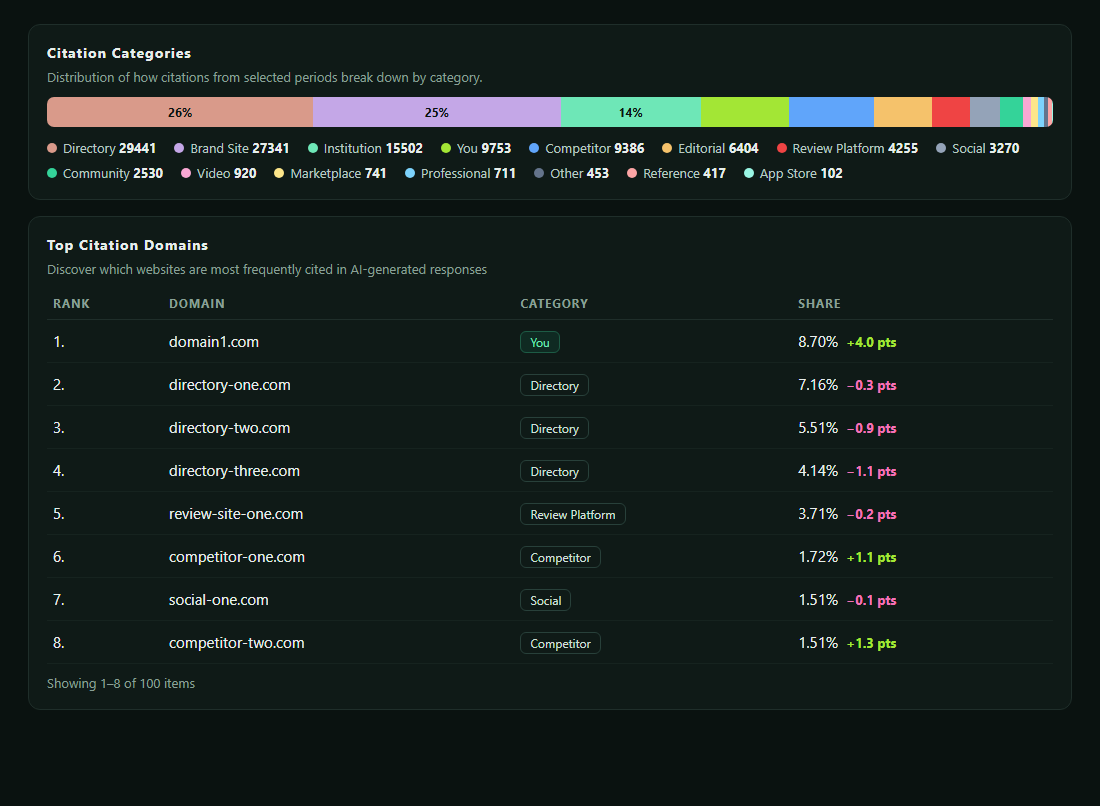
We read this as: Directory is the largest category, so a directory listing is one of the first places to check.
Which pages do they cite?
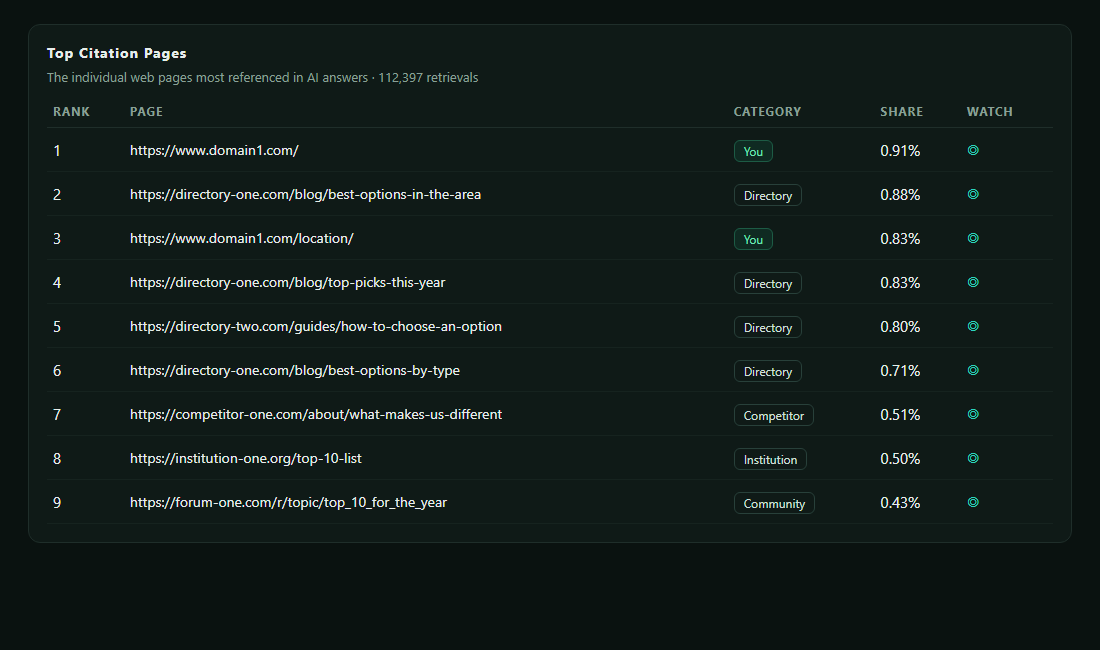
"Top Citation Pages" lists individual pages across 112,397 retrievals. No single page dominates: the most-cited has a 0.91% share. Of the top 15, 9 are Directory pages and only 2 are the brand's own; the rest are Competitor, Institution and Community pages.
How do you follow a page?
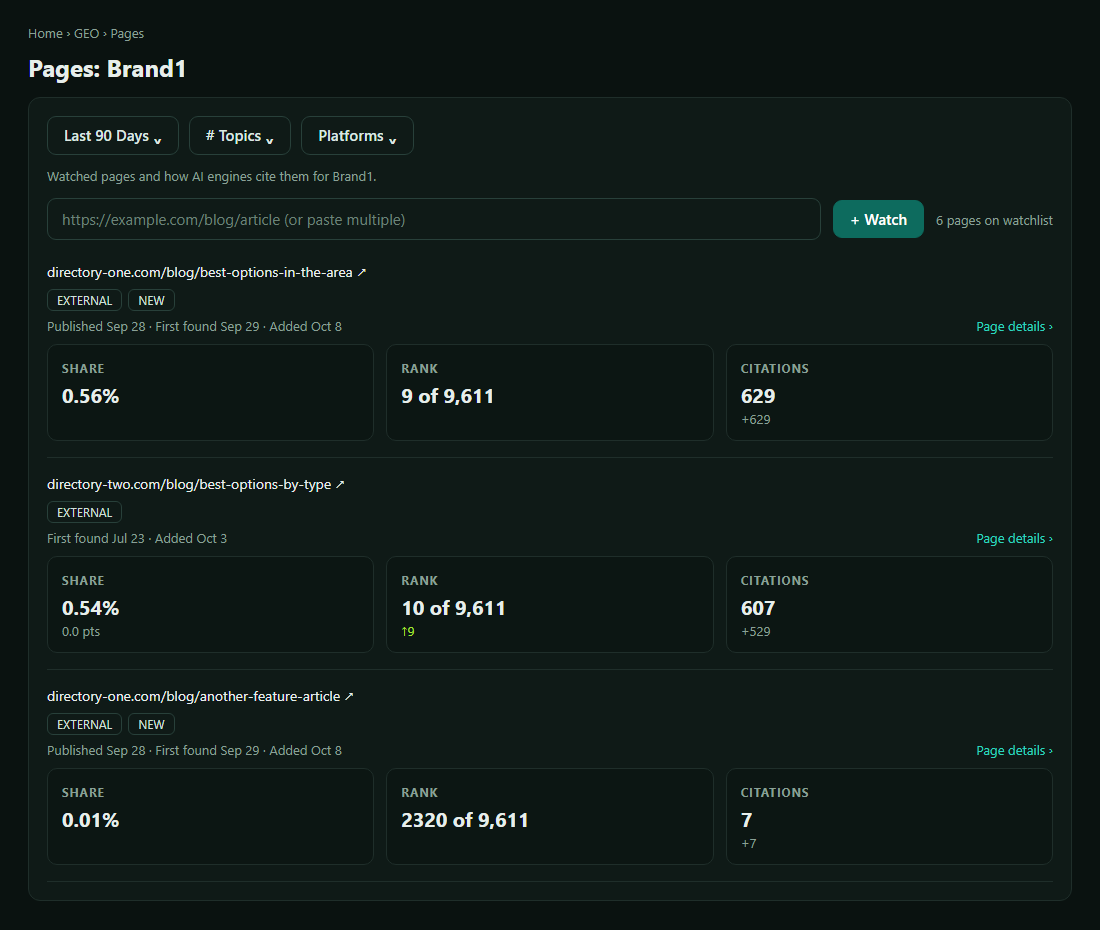
"Pages," under GEO, is a watchlist. Paste a page address and press "+ Watch." Each card shows "SHARE," "RANK" and "CITATIONS" with a change. A page that is not ranked says why. Our Pages docs say the figures count answers to unbranded prompts, the questions buyers ask before they know who to pick. In the example account, the best of 6 watched pages had a 0.56% share, rank 9 of 9,611 and 629 citations.
Which Citations Should You Target First, and What Can Our Actions Do?
Action cards name a specific page, the kind of move and how many AI answers it affects, so you can start with the largest.
Our action plan turns what AI answers said into a ranked list of moves. Each shows why, your gap (what the winning pages have that you do not), reach (how many AI answers it could win back) and a verdict.
In the Agent Hub, which is in beta, the "AI CMO" shows moves as action cards. Each names a page, a kind of move ("Get listed," "Move up," "New page," "Join the thread" or "Verify listing") and how many AI answers it affects, such as 109 for one "Get listed" card in the example account. A "New page" card reached "Review," where a page drafted by our Content Agent waits for you. Nothing is sent or published without your OK.
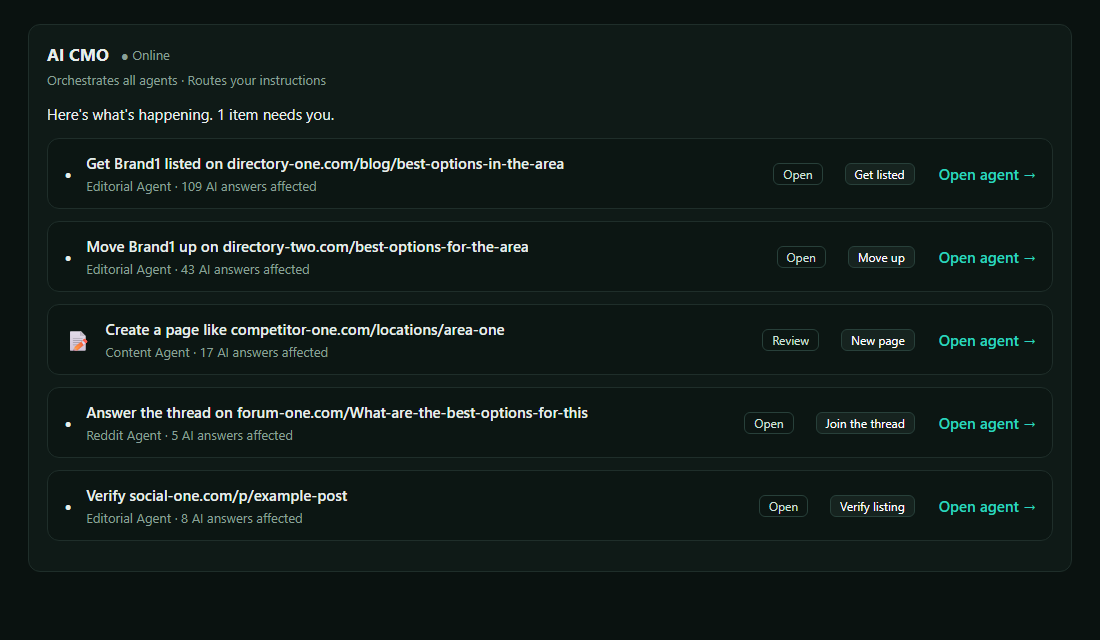
We suggest starting with the card that affects the most AI answers. After you act, our next checks of your prompts measure whether the answers changed, and "Pages" shows how that page's citations moved.
What Should You Do This Month?
Read the Citations tab, watch two or three third-party pages, start with the biggest action card, and check back in four weeks.
- Read "Citation Categories".
- Check "Top Citation Domains" and note where your brand is missing.
- Add two or three third-party pages from "Top Citation Pages" with "+ Watch."
- Open the Agent Hub and start with the card that affects the most AI answers.
- Check "Pages" again in about four weeks.
FAQ
Do backlinks still matter for AI answers?
The evidence does not say they stopped mattering. In one vendor-run study, mentions correlated more strongly than backlinks with brand mentions in Google AI Overviews (0.664 against 0.218), but correlation is not causation. Google's guide has no link-building advice.
See Citations on Example Data
Browse our public sample report, which is labeled "Dataset: Illustrative example, not a real measurement of any brand," to see example data. When you are ready to look at your own category, book a live demo for a 30-minute visibility review with one of our specialists.
- Google users are less likely to click on links when an AI summary appears (opens in a new tab) Pew Research Center, July 22, 2025 · pewresearch.org · 900 U.S. adults, Google only
- New Research: AIs are highly inconsistent when recommending brands or products (opens in a new tab) SparkToro, Jan 27, 2026 · sparktoro.com · not peer-reviewed; disclosed conflict of interest
- An Analysis of AI Overview Brand Visibility Factors (75K Brands Studied) (opens in a new tab) Ahrefs, May 26, 2025 · ahrefs.com · vendor-run, Google AI Overviews only
- Generative Engine Optimization: How to Dominate AI Search (opens in a new tab) Chen, Wang, Chen and Koudas, University of Toronto, September 2025 · arxiv.org · consumer product queries
- Earned media still drives 84% of AI citations (opens in a new tab) Muck Rack, May 2026 · muckrack.com · vendor-run, no methodology on the page
- AI features and your website (opens in a new tab) Google Search Central, December 10, 2025 · developers.google.com · Google's guidance, not a guarantee
- Optimizing your website for generative AI features on Google Search (opens in a new tab) Google Search Central, July 10, 2026 · developers.google.com · Google's guidance, not a ranking guarantee